

From one idea developed in Norway to more than 450 projects across 45 countries, ACAMS Airport Tower Solutions celebrates 25 years of innovation, international growth and teamwork.

From one idea developed in Norway to more than 450 projects across 45 countries, ACAMS Airport Tower Solutions celebrates 25 years of innovation, international growth and teamwork.
This year, ACAMS Airport Tower Solutions celebrates its 25th anniversary – a milestone that provides an opportunity not only to celebrate, but also to look back at how far the company has come.
For a quarter of a century, ACAMS has been helping airports and Air Navigation Service Providers (ANSPs) digitize their operations, simplify complex environments and enhance safety. By combining deep technical expertise with a strong understanding of operational realities, we develop solutions that improve efficiency, reduce controller workload and contribute to safer and more resilient air traffic operations.
Today, ACAMS solutions can be found around the world, with more than 450 projects delivered across 45 countries – from Greenland to Brazil and from Hungary to Singapore.
But the ACAMS story started much more modestly: with three people, one idea and a challenge to solve.
The origins of ACAMS go back to the development of what would become our flagship I-TWR Integrated Tower solution.
Around the turn of the millennium, Norway’s air navigation service provider – then Luftfartsverket and today Avinor – was looking for a way to address the increasing complexity of operating an air traffic control tower.
Controllers had to interact with multiple individual systems, covering everything from navigation aids and airfield lighting to meteorological information. The idea behind I-TWR was straightforward but ambitious: why not integrate the monitoring, control and display of these different systems into one common working environment?
I-TWR was developed to give controllers a simplified interface through which multiple airport and ATC systems could be monitored and controlled from one integrated presentation.
Following the successful first implementation, ACAMS was established and the potential to take the concept beyond Norway quickly became apparent.
International growth did not happen overnight.
Shortly after ACAMS was founded, the events of 9/11 dramatically changed investment priorities across the aviation industry, with significant resources redirected towards security. It consequently took several years before the first international I-TWR projects followed.
The Middle East and North Africa became important early markets, with projects in Abu Dhabi, Doha and Egypt helping demonstrate the potential of the integrated tower concept internationally.
A particularly important breakthrough came in Brazil.
In 2007, ACAMS developed a large proof-of-concept installation for DECEA, the organization responsible for Brazil’s airspace control. The successful demonstration was followed by an international tender and an initial contract covering six airports.
It marked the beginning of a long-term relationship and established ACAMS as an important technology partner in the modernization of Brazil’s ATC tower infrastructure.
While I-TWR established the foundation of the company, ACAMS continued developing new solutions around the same fundamental philosophy: use technology and systems integration to make complex operations simpler for the people who manage them.
One important example was the development of ACAMS’ computerized ATIS – Automatic Terminal Information Service.
The solution automatically generates voice messages from data and text inputs, combining information such as runway meteorological data with standard arrival and departure information before transmitting it to pilots.
When the ACAMS ATIS solution was first deployed in Saudi Arabia in 2004, synthesized computer speech represented a significant technological step forward. Automating the process helped reduce controller workload while providing pilots with consistent operational information.
The technology continued to evolve. Major deployments over the years included ATIS installations across 42 airports in India, while another landmark was the implementation at Singapore Changi Airport, one of the world’s leading international airports.
Over the years, systems integration has increasingly become one of the defining capabilities of ACAMS.
Rather than simply supplying individual products, ACAMS has developed extensive experience in connecting different airport and ATC technologies and presenting information through interfaces that make those systems easier to operate and manage.
That capability also positioned ACAMS well for the emergence of remote and digital tower environments. The principle behind I-TWR – bringing information from multiple systems together into a common operational environment – naturally lends itself to an increasingly digital ATC infrastructure.
The same philosophy has subsequently been extended beyond the controller working position to areas such as technical control and monitoring, enabling users to monitor systems, establish alarms and conditions, and manage increasingly complex technical environments from integrated platforms.
At the same time, ACAMS itself has evolved from being more hardware-oriented towards modern web-based architectures, software-driven solutions and increasingly flexible deployment models.
What has remained constant is the objective: simplifying complexity through integration.
International cooperation has been part of ACAMS almost from the start.
Following a contract in Tunisia in 2003, ACAMS established a local engineering team to support the project. This approach to combining expertise in Norway with people and partners closer to customers subsequently became part of the company’s international way of working.
Over the years, ACAMS has worked directly with ANSPs and airport operators while also cooperating with major international technology and engineering companies on larger infrastructure programmes.
This combination has allowed ACAMS to remain relatively agile while participating in some highly complex international ATC projects.
Twenty-five years after those first developments in Norway, the numbers tell part of the story: more than 450 projects in 45 countries.
Behind those numbers, however, are hundreds of individual challenges solved together with customers and partners – and a team that has continued to develop ACAMS technology and expertise as the air traffic management environment itself has evolved.
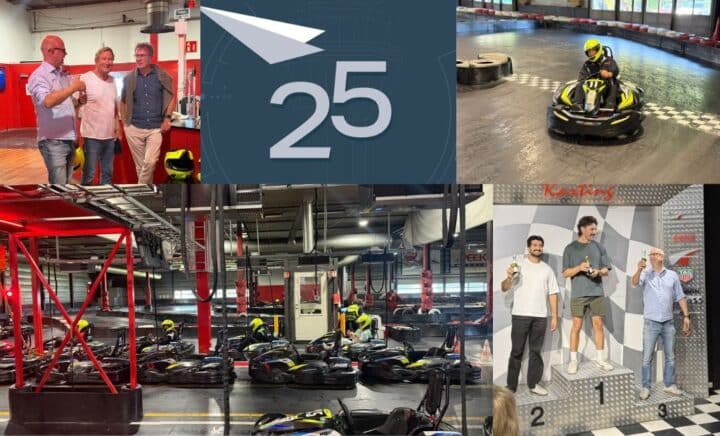
And a milestone like this deserves to be celebrated with the people who made it possible.
We kicked off our 25th-anniversary celebrations at our Oslo office – with celebrations at other ACAMS locations to follow – with some friendly competition on the karting track, followed by a team dinner.
Congratulations to our podium finishers:
1st: Willis Flanders, Sales
2nd: Raj Singh, Project Management
3rd: Kim Ronny Gyth, COO
And a special mention to Odd Thodesen, Director Business Development, for setting the fastest lap of the evening.
It was a great evening with our Oslo-based team and an opportunity to celebrate not only 25 years of technology and projects, but above all 25 years of people, expertise, customer relationships and teamwork.
Much has changed since ACAMS began with three people and one idea. Air traffic management has become increasingly digital and interconnected, and the technologies available to airports and ANSPs continue to evolve.
For ACAMS, however, the ambition remains remarkably similar to the one that started the company 25 years ago: take something complex and make it easier to operate, control and manage.
Congratulations to everyone who has contributed to the ACAMS journey – employees, customers and partners alike.
Here’s to the next 25 years.